
By: Emily Beach, Head of Data & Insights UK
Education in the UK is evolving as new technology, changing skills and growing expectations influence what parents want from schools. As children across the country return to the classroom for a new school year, Pureprofile research reveals that parents are thinking not only about academic achievement, but also the wider challenges children face and how schools can prepare them for the future.
Our survey of 500 UK parents of children aged 5 to 17, nationally representative by region, explores their biggest concerns for the school year ahead, the skills they want schools to prioritise and their attitudes towards the growing use of AI in education.
Academic success matters, but parents are looking beyond grades
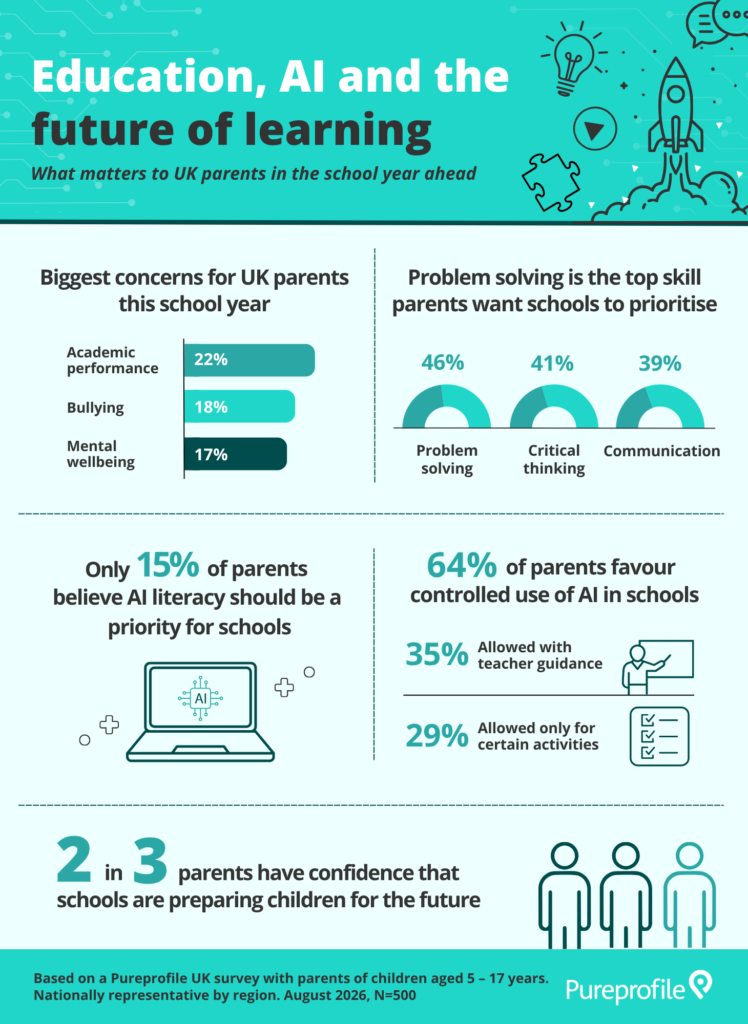
Academic performance is the biggest concern for 22% of UK parents this school year. However, the findings show that achievement is only one part of the picture.
18% of UK parents say bullying is their biggest concern, while 17% are most concerned about mental wellbeing. Cost follows at 14%, with safety at 11% and screen time at 10%.
Together, the results highlight the range of considerations on parents’ minds as children return to school. Academic progress remains important, but parents are also thinking about the social and emotional experiences that surround children’s education.
Despite the growing debate around technology in schools, only 5% of UK parents say AI and technology is their biggest concern for the school year ahead. However, when the focus shifts from immediate concerns to what children should be learning, technology becomes part of a much broader conversation about preparing for the future.
Future skills extend well beyond the traditional curriculum
Parents place considerable importance on practical and transferable capabilities when considering which skills schools should prioritise.
Problem solving is the top skill UK parents want schools to prioritise. But it’s closely followed by several other skills spanning communication, financial knowledge, technology and resilience.
The five leading priorities are:
- Problem solving 46%
- Critical thinking 41%
- Communication 39%
- Financial literacy 38%
- Digital safety 37%
Mental resilience is not far behind at 35%, while creativity is selected by 26%. The breadth of these priorities suggests parents expect education to equip children with capabilities that can be applied beyond academic study, helping them navigate future work, personal finances, technology and everyday decision making.
Only 15% of UK parents believe AI literacy should be a priority for schools. It ranks considerably below digital safety, suggesting parents currently place greater emphasis on navigating the digital world safely than developing specific knowledge of AI.
The findings also point to the continued importance of distinctly human capabilities. Problem solving, critical thinking and communication all sit at the top of the list despite the increasing role technology is expected to play in children’s futures.
Parents want a measured approach to AI in the classroom
While AI literacy ranks relatively low as a learning priority, parents are not rejecting the technology itself.
64% of UK parents favour controlled use of AI in schools, either with teacher guidance or only for certain activities. More than a third (35%) believe AI should be allowed with teacher guidance, while 29% think its use should be limited to certain activities.
At either end of the spectrum, views are remarkably similar. 15% of UK parents believe AI should be actively encouraged in schools, compared with 13% believe it should not be used at all. A further 7% are unsure.
When it comes to AI in education, the middle ground currently has the greatest support. For many parents, the question may be less about whether AI belongs in education and more about how it is introduced and managed. Teacher involvement and clear boundaries could therefore be important as schools determine where AI can support teaching and learning while continuing to develop the broader skills parents value.
Looking further ahead, there is a positive foundation for UK education to build on. 65% of parents in the UK are confident that schools are preparing children for the future. However, only 16% are very confident, compared with 49% who are somewhat confident. A further 22% are neutral and 13% express a lack of confidence
As the new school year begins, the findings reveal expectations that stretch beyond academic achievement alone. Parents want children to develop the skills to solve problems, think critically and communicate effectively, while schools find the right role for new technology in the classroom. For UK education, the challenge is not simply preparing children for another school year, but equipping them for what comes next.
The infographic series below represents key findings from our research:
Based on a Pureprofile UK survey of 500 parents in the UK with children aged 5–17 years, nationally representative by region. August 2026.