
As Easter approaches, many Australians are rethinking their plans, not because they want to, but because they have to.
Rising fuel prices, driven by global instability and supply pressures, are placing renewed strain on household budgets.
Behind this spike are global factors largely outside Australia’s control. Ongoing geopolitical tensions have disrupted supply chains and pushed oil prices higher, while Australia’s reliance on imported fuel leaves local prices particularly vulnerable. In some cases, prices have even exceeded $3 per litre, highlighting the severity of current conditions.
To understand what this means for Easter travel, we surveyed 1,008 Australians. The findings show a clear shift in behaviour: people are scaling back, staying closer to home, and prioritising affordability over aspiration.
A shift towards local, value-driven travel
As fuel prices rise, consumers are becoming more deliberate in their decisions. Our research shows that many are prioritising proximity over distance, opting for shorter, lower-cost experiences, or reconsidering travel altogether. Even with measures aimed at easing fuel costs, relief may take time to reach households, leaving many Australians cautious in their spending.
Easter in 2026 isn’t cancelled, but it is being redefined. As cost-of-living pressures continue to shape behaviour, one thing is clear: when fuel prices rise, travel plans shrink.
The infographic below represents key findings from our research:
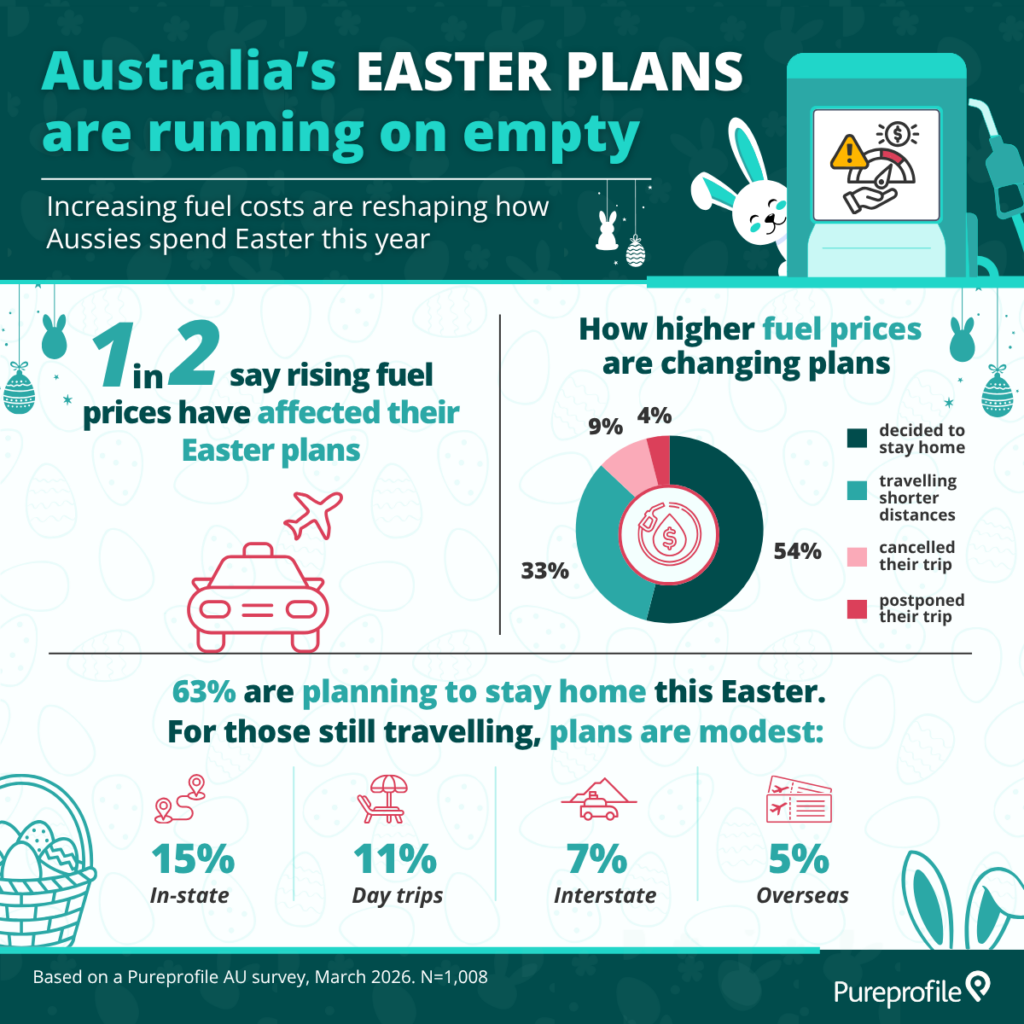
Based on a nationally representative Pureprofile survey of 1,008 in Australia, March 2026.